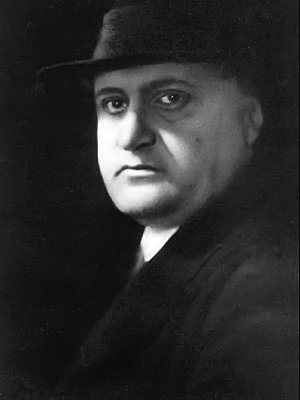
Federigo Tozzi (1883–1920) was one of the most original Italian novelists of the early twentieth century and is now recognized as a major figure of European modernism. Born in Siena, the son of a forceful innkeeper and landowner, Tozzi drew deeply on the physical and psychological world of Tuscany: its farms, steep medieval streets, provincial families, religious tensions, economic rivalries, and forms of patriarchal authority. His difficult relationship with his father and his own troubled education left lasting traces throughout his fiction. After early experiments in poetry and journalism, Tozzi developed a radically personal form of psychological narrative. Rather than explaining his characters, he exposed their hesitations, involuntary gestures, obsessions, cruelties, fears, and failures of perception. His prose combines an intense attachment to concrete reality with a distinctly modern sense of the instability of consciousness. His major works include “Bestie”, “Con gli occhi chiusi” (With Eyes Closed), “Tre croci”, “Il podere”, and “Gli egoisti”. Some of his most important books appeared only shortly before or after his premature death in Rome in 1920, at the age of thirty-seven. Long regarded as a provincial or late realist writer, Tozzi has increasingly been placed alongside Italo Svevo and Luigi Pirandello as one of the authors who transformed the Italian novel, and within the broader European constellation of Kafka, Musil, Joyce, and Woolf. His fiction remains strikingly modern for its portrayal of divided selves, failed communication, oppressive families, erotic anxiety, and the mysterious violence hidden within ordinary life.
HoleniaBooks
Italian Literature
With Eyes Closed
Federigo Tozzi’s “With Eyes Closed” is one of the secret masterpieces of European modernism: a novel of desire, illusion, family violence, social unease, and the terrifying distance between what we see and what we are capable of understanding. Set between Siena, Florence, and the Tuscan countryside, the novel follows Pietro Rosi, a sensitive and uncertain young man crushed by the vitality of an authoritarian father and consumed by his obsessive love for Ghisola, a former farm girl whom he transforms into an ideal of purity. But Ghisola belongs to a harsher world than the one Pietro imagines, and the closer he comes to possessing her, the more completely reality escapes him. Tozzi turns provincial Tuscany into a psychological landscape as unsettling as Kafka’s Prague, as inwardly fractured as Svevo’s Trieste, and as unstable in its sense of identity as the worlds of Pirandello and Musil. His lonely characters, trapped within desires they cannot explain, may also remind American readers of Sherwood Anderson’s “Winesburg, Ohio”, while the brutal tensions of family, property, rural life, and inherited violence look forward—without any question of direct influence—to the dark provincial universes later created by William Faulkner. Yet Tozzi’s voice remains unmistakably his own. Animals, houses, streets, trees, railway cars, gestures, and sudden flashes of landscape acquire the emotional intensity of human events. Beauty offers no consolation. Love becomes a form of blindness. Consciousness itself proves unreliable. Published in 1919, “With Eyes Closed” dismantles the traditional coming-of-age novel and replaces it with something far more modern: the story of a man who looks incessantly and understands almost nothing. Its final revelation is among the most abrupt and devastating endings in twentieth-century Italian fiction. For readers of Kafka, Svevo, Pirandello, Musil, Sherwood Anderson, and Faulkner, “With Eyes Closed” offers the discovery of a writer who belongs naturally in their company.

Visualizza il libro