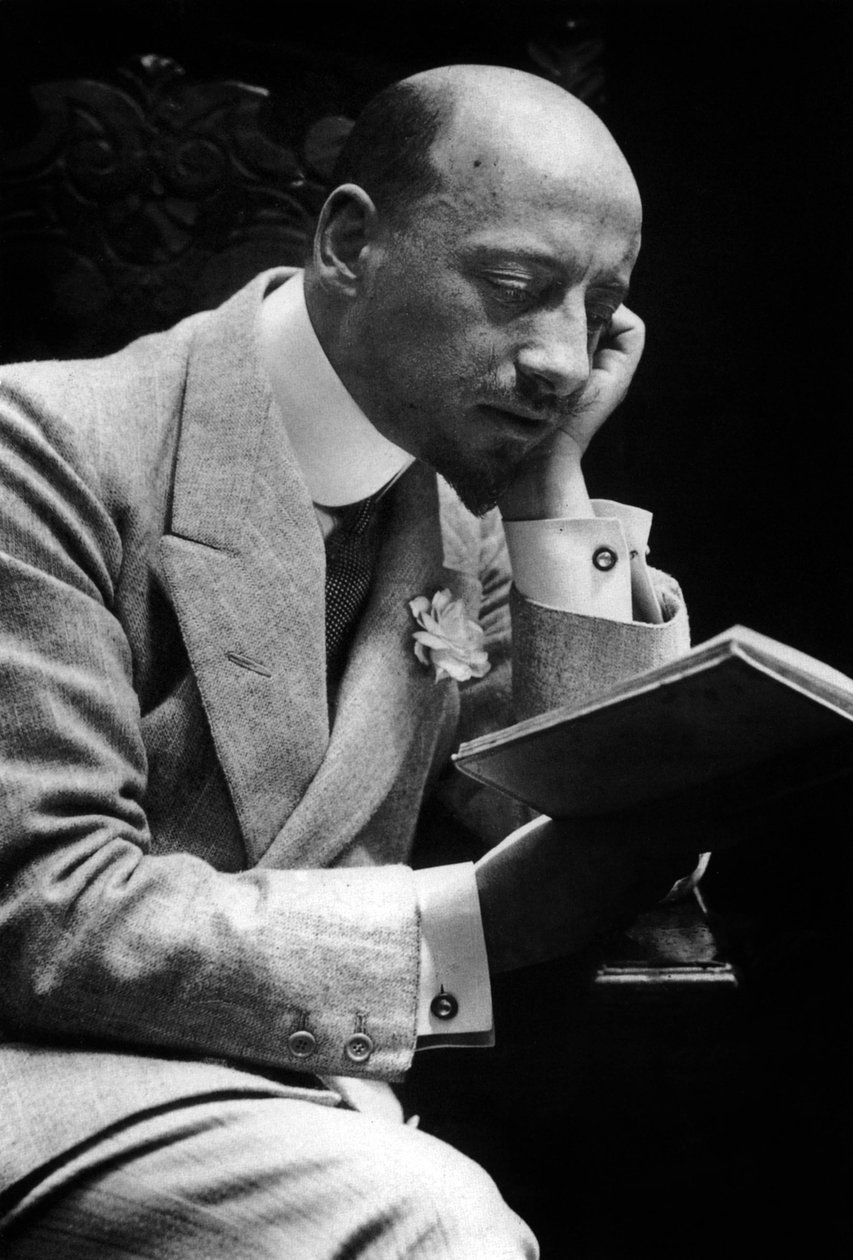
Gabriele D’Annunzio (1863–1938) was one of the most influential Italian writers of the late nineteenth and early twentieth centuries. Poet, novelist, dramatist, journalist, and public figure, he played a decisive role in the development of Italian Decadentism and in the renewal of modern Italian literary language. Born in Pescara, in Abruzzo, D’Annunzio achieved early fame as a poet before establishing himself as a novelist with works such as “Il piacere” (1889), “L’innocente” (1892), “Il trionfo della morte” (1894), “Le vergini delle rocce” (1895), and “Il fuoco” (1900). His writing combines psychological analysis, aestheticism, classical and Renaissance culture, sensuality, symbolism, and an extraordinary attention to the musical and visual qualities of prose. Among his major poetic achievements is “Alcyone”, while his dramatic works include “La città morta”, “Francesca da Rimini”, and “La figlia di Iorio”. His career was also marked by his involvement in Italian nationalism, his military exploits during the First World War, and the occupation of Fiume in 1919–1920. D’Annunzio spent his later years at the Vittoriale degli Italiani on Lake Garda, where he died in 1938. His work remains central to the study of European Decadence, fin-de-siècle culture, and the emergence of literary modernity.
HoleniaBooks
Italian Literature
The Triumph of Death
Gabriele D’Annunzio’s “The Triumph of Death” is one of the most intense and ambitious novels of European Decadence: a work in which erotic passion, psychological obsession, aesthetic experience, heredity, and the fascination of death converge within a prose of extraordinary sensuous power. At its center stands Giorgio Aurispa, a man consumed by self-analysis and by an increasingly destructive love for Ippolita Sanzio. Their relationship becomes the field upon which desire and jealousy, possession and estrangement, physical attraction and spiritual isolation are tested to their limits. Around this private drama D’Annunzio constructs a world of exceptional richness: Rome in rain and twilight, the ancestral house, the Adriatic coast, the landscapes and rituals of Abruzzo, popular devotion, peasant life, Wagnerian music, and the troubling promise of Nietzschean self-overcoming. D’Annunzio conceived the novel not as a conventional sequence of events, but as the representation of a consciousness in continuous transformation. His “plastic and symphonic prose” proceeds through recurring images, rhythms, sensations, memories, and symbolic correspondences, turning landscape and music into extensions of the protagonist’s inner life. The result is at once a psychological novel, an erotic tragedy, and a major experiment in modern prose. Published in 1894, “The Triumph of Death” remains one of D’Annunzio’s central works and one of the most uncompromising literary documents of the fin de siècle. This complete and unabridged edition restores the novel in its full breadth, preserving the density, musicality, and intellectual complexity of D’Annunzio’s original conception.

Visualizza il libro