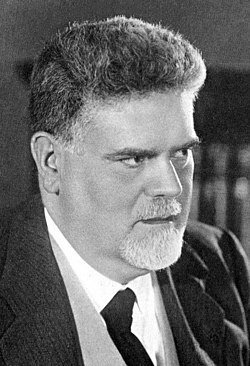
Giovanni Gentile (1875–1944) was one of the leading figures of twentieth-century Italian philosophy and the founder of Actualism, the distinctive form of Italian Idealism centred on the concept of thought as pure act. A philosopher, historian of ideas, educational theorist, and major organiser of Italian cultural life, he taught at the universities of Palermo, Pisa, and Rome and served as Minister of Public Education from 1922 to 1924. Among his principal philosophical works are “The Reform of Hegelian Dialectic”, “The General Theory of Spirit as Pure Act”, and the “System of Logic as Theory of Knowledge”. He also devoted extensive studies to the major figures of the Italian literary tradition, including Dante, Manzoni, and Leopardi, approaching literature as a living expression of philosophical, moral, and historical consciousness. Gentile’s political commitment to Fascism, and later to the Italian Social Republic, remains an essential and controversial part of his historical legacy. He was assassinated in Florence on 15 April 1944. His philosophical and critical writings nevertheless remain central to the study of Italian Idealism and of twentieth-century interpretations of Italy’s intellectual and literary tradition.
HoleniaBooks
Italian Literature
Studies on Dante
Giovanni Gentile’s “Studies on Dante” is far more than a collection of essays on the author of the “Divine Comedy”. It is a sustained philosophical interpretation of Dante’s place in the history of Italian thought and of the extraordinary unity, within his work, of poetry, philosophy, theology, politics, and national consciousness. Against readings that separate the poet from the thinker, Gentile insists upon the organic character of Dante’s intellectual world. In the “Comedy”, philosophical doctrine is not an external framework imposed upon poetry: it becomes part of the living substance of the poem itself. Virgil and Beatrice, reason and faith, Empire and Church, freedom and transcendence all belong to a single spiritual drama whose ultimate subject is the human ascent from disorder toward truth. Particular importance is given to the “Convivio”, the “Monarchia”, and Dante’s revolutionary use of the vernacular. For Gentile, Dante does not merely write philosophy in Italian: he creates a language capable of philosophical thought and, in doing so, helps give form to Italy as a spiritual and cultural reality. The “Divine Comedy” thus becomes at once the culmination of medieval scholasticism and the beginning of a distinctively Italian philosophical tradition. Written with the force of one of the major European idealist philosophers of the twentieth century, “Studies on Dante” remains a compelling meditation on the relation between thought and poetry, faith and reason, individual genius and historical destiny.

Visualizza il libro