
Monia Moroni was born in Ancona, Italy, in 1973. She holds a degree in Social Work and has also studied sculpture. After living in Piedmont for twenty years, she now resides in Osimo, in the Marche region. She made her literary debut in 2020 with “Operette in Marca. Versi d’una guardiana dell’armadio di scarpe”, followed by “Svola Balena! Poesie allo stato gassoso” (2021) and “Dell’amore e della carne” (2022; second edition, HoleniaPoesia, 2025). With “Binary Star”, she explores a poetic language suspended between lyric poetry and prose. She has also edited works by Dino Campana and Giovanni Boine and contributed to literary journals, cultural magazines, and editorial projects in Italy and abroad.
HoleniaBooks
Italian Literature
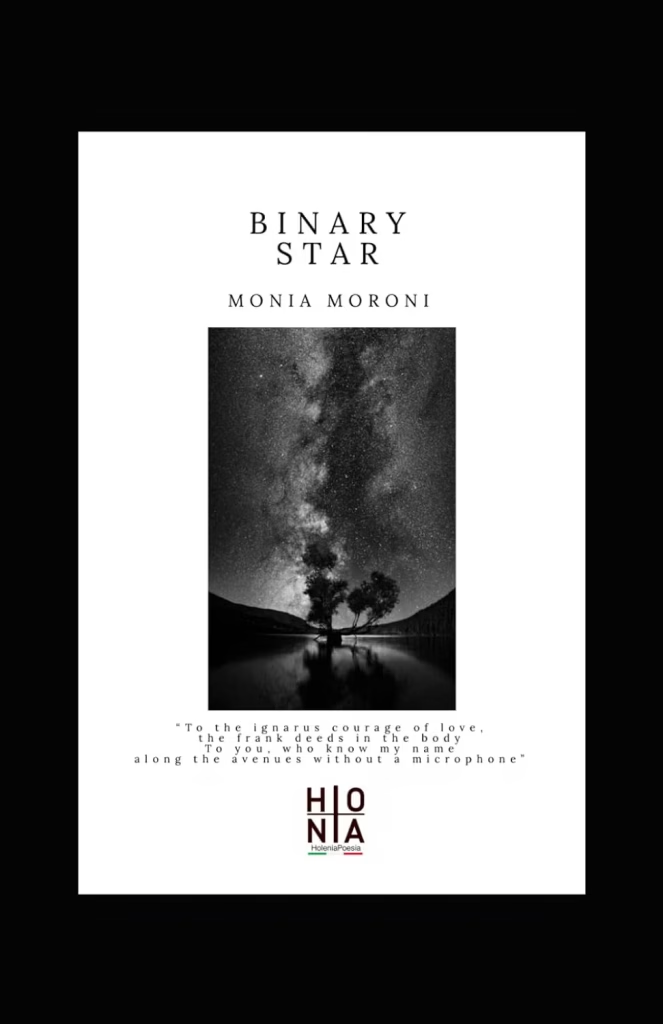
Binary Star
“Binary Star” is a book of attraction, distance, and luminous collision. In Monia Moroni’s poetry, the body becomes landscape and the landscape becomes body. Stars, blood, water, wind, flowers, animals, rooms, roads, and fragments of memory are drawn into a language that moves continuously between lyric poetry and lyrical prose, between physical experience and the desire for transcendence. At the center of the collection lies the image of the binary star: two celestial bodies bound to one another by an invisible force, separate yet inseparable. It becomes a figure for love, memory, desire, absence, and the mysterious relation between the individual and the cosmos. Moroni’s writing proceeds through sudden associations, ruptures, recurring images, and visionary condensations. The everyday is never merely everyday: a cigarette, a window, a chair, a shoreline, or a human gesture may unexpectedly open onto myth, the sacred, or the infinite. Rooted in the Italian and European poetic tradition yet unmistakably personal in voice, “Binary Star” is a collection in which language does not explain experience so much as expose it to wonder. A poetry of flesh and constellations, of wounds and light, of the visible world and what trembles just beyond it.
Visualizza il libro
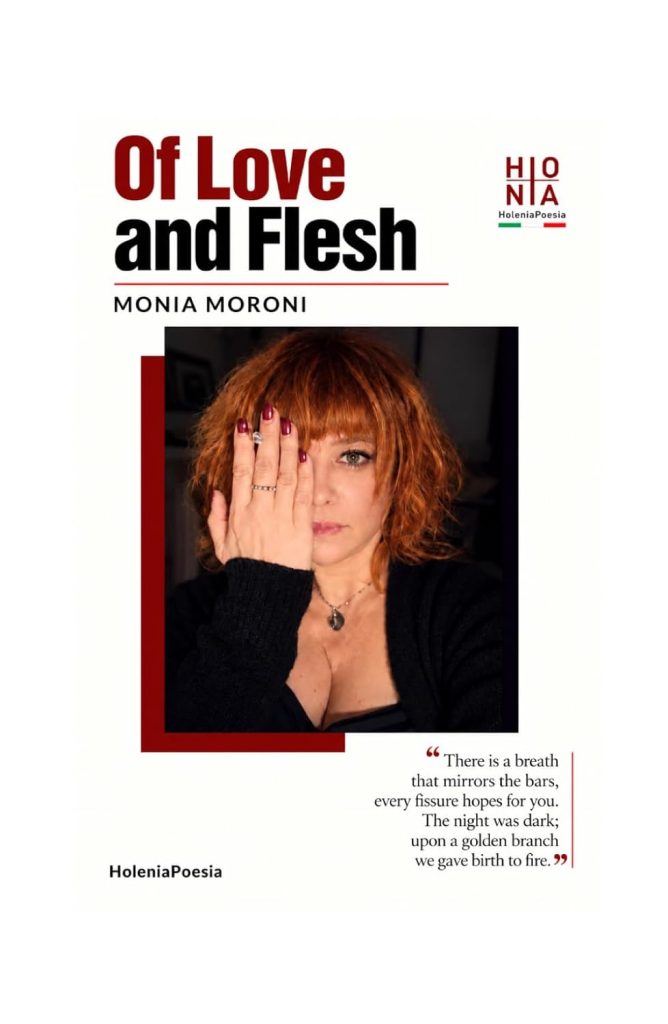
Of Love and Flesh
In “Of Love and Flesh”, Monia Moroni enters the most ancient territory of lyric poetry — love, desire, the body — and makes it strange again. Here flesh is never merely flesh. It becomes threshold, wound, revelation, memory, prayer. Lovers move through seas, stars, forests, blood, fire, bells, animals, sacred symbols and sudden flashes of myth; bodies dissolve into landscapes, landscapes enter the body, and erotic experience acquires the intensity of a metaphysical event. Moroni’s language is compressed, visionary and tactile. Her images do not explain: they strike, open, collide. A birch rose springs from stone; rain rises and returns as crystal; a body becomes milk; the sea becomes lover; a hand enters the soul. Love is repeatedly imagined as a force capable of breaking the boundaries of the isolated self and restoring, however briefly, a lost unity. Divided into “Of Love” and “Of Flesh”, the collection does not separate spirit from body, but reveals their profound continuity. In this sense Moroni enters into dialogue with a poetic lineage that reaches from Sappho and the mystical tradition to Rilke, Whitman, H.D. and Hart Crane, while preserving a voice unmistakably her own: intimate, sensual, restless, at times violent, always searching for a language adequate to what the body knows before thought can name it. “Of Love and Flesh” is not simply a book of love poems. It is a book about what love does to identity, language and perception — about the moment when the body becomes word, and the word becomes flesh.
Visualizza il libro